AVANSA® › Advice: pumps, thermostats, backup power and a safe boiler room
AVANSA® · advice

Advice: pumps, thermostats, backup power and a safe boiler room

Practical tips for homeowners and installers alike – from a boiler room with a solid-fuel boiler, through choosing a pump and setting a thermostat, to sizing a battery and detecting gas. If you get stuck, our technician will advise you by phone.

updateUpdated: verifiedTechnically reviewed by the ATRIA SK s.r.o. technicians

local_fire_departmentSolid-fuel boilersthermostatHeating settingsbattery_charging_fullUPS backup sizingsupport_agentTechnician +421 917 133 664
menu_bookContents

What you will find in this advice section

The seven topics our ATRIA technicians deal with most often, a pre-winter checklist and a quick product selector by situation. You will find an overview of the whole brand on the AVANSA® home page.

local_fire_department

Boiler room with a solid-fuel boiler

Pump, backup power supply and a cooling loop with a safety valve. Read →

autorenew

Circulation pump

How to read the designation, choose a replacement and swap the pump. Read →

thermostat

Thermostat and savings

Night setback, room temperatures, underfloor heating versus radiators. Read →

battery_charging_full

Backup power supply

Sizing the output and battery, wiring and battery maintenance. Read →

sensors

Gas and CO

Gas detector vs. CO detector, correct placement and what to do in an alarm. Read →

filter_alt

Magnetite and sludge

Why black water from a radiator destroys the pump and boiler, and how to capture it. Read →

electric_bolt

Heating elements

A warm towel radiator in the bathroom even outside the heating season. Read →

checklist

Checklist and quick selector

Eight steps before winter and a “situation → solution” table. Read →

local_fire_departmentBoiler room safety

A boiler room with a solid-fuel boiler – the essentials

A wood, coal or coke boiler cannot be switched off at the press of a button. When the power goes off, the fire keeps burning – and that is exactly when the boiler room equipment makes all the difference.

With a gas or electric boiler, a power cut stops the burner and the pump at the same time, and nothing serious happens. A solid-fuel boiler works differently: glowing fuel remains in the combustion chamber and keeps producing heat long after you stop stoking it. If the circulation pump stops, the water in the boiler stops passing heat to the radiators, heats up rapidly and is at risk of boiling, with the boiler overheating and the heat exchanger or pipework being damaged. A safe boiler room therefore rests on three pillars: a reliable pump with sensible control, a backup power supply for the pump and an independent cooling loop with a safety valve.

1. The circulation pump and its control

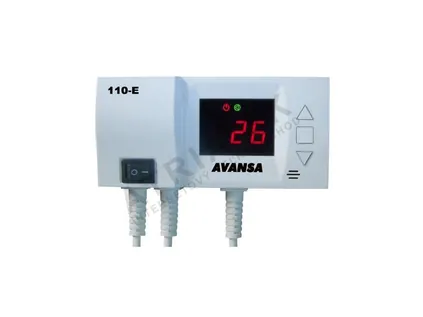
The pump in the boiler circuit must run whenever the boiler is hot, but does not need to run when the boiler is cold. That is what the Avansa 110 C and Avansa 110 E boiler thermostats are for: the sensor measures the boiler temperature and switches the pump on only once the set temperature is exceeded, then switches it off again when the boiler goes out and cools down. The manufacturer states that, depending on how the boiler is used, this can save up to 60% of the electricity used to run the pump while also extending its service life.

  • Avansa 110 C – switch-on temperature 10–90 °C; it switches the pump off when the temperature drops 5 °C below the set value. Switching on and off takes place with a delay of approximately 30 seconds, so the pump does not click on and off with brief temperature fluctuations. It also has a switch for running the pump manually.
  • Avansa 110 E – setting 5–80 °C, plus an anti-seize function (outside the heating season, it runs the pump for 15 seconds every 15 days so that it does not seize up) and frost protection (it switches the pump on below 5 °C).
  • Avansa 110 Z – if you have a hot water cylinder as well as heating: it controls two pumps with optional DHW priority, and in summer mode it switches the heating pump on only when the boiler temperature exceeds 90 °C, protecting the boiler from overheating.
  • Avansa TH 2A clamp-on thermostat – the simplest and cheapest solution. It is fixed directly onto the pipe (up to 2" in diameter) with a spring and uses a bimetallic strip to switch the pump's live wire in the range of 20–90 °C. It is most commonly used precisely for controlling boiler pump overrun.

You will find an overview of all controllers with their specifications on the AVANSA thermostats and controls page.

2. A backup power supply (UPS) for the pump

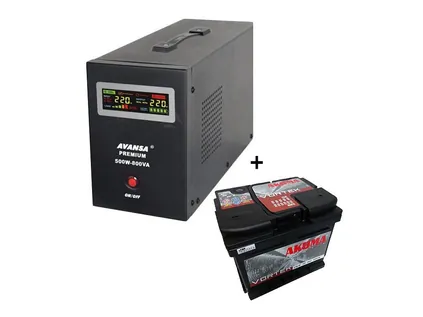
Neither a thermostat nor the best pump will help when there is no electricity. AVANSA backup power supplies are designed specifically to provide continuous power to circulation pumps on solid-fuel boilers: when the mains fails, they switch to battery within 4 ms and the pump keeps running until the boiler has cooled down safely. Their output is a pure sine wave, the same as the mains in your home, so neither the pump nor the boiler electronics are affected. How to choose the right unit and battery is explained below in Backup power supply – sizing and battery maintenance.

3. A cooling loop with a safety valve

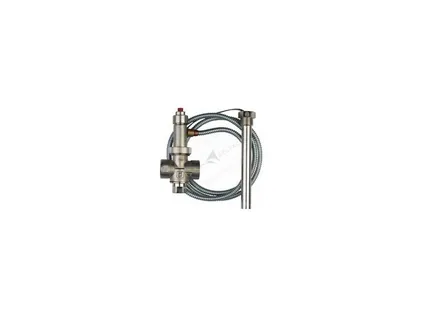
The backup power supply is the first line of defence, but a battery will eventually run flat and any piece of equipment can fail. That is why a solid-fuel boiler also needs a purely mechanical safeguard that does not depend on electricity: a cooling loop – a heat exchanger built into the boiler – and a thermostatic safety valve. The AVANSA STS safety valve (WATTS STS 20) kicks in when the boiler overheats above 97 °C: it lets cold mains water into the cooling loop, which draws heat away from the boiler, and the heated water drains away. The valve protects all types of solid-fuel boilers and stoves (coal, wood, coke) against boiling in the central heating system and is available with 1/2" FF and 3/4" FF connections.

  • The valve must be connected to the cooling loop and to the cold water supply. Without pressurised cold water, it has nothing to cool with.
  • The cold water supply to the loop needs pressure even during a power cut. If you have your own well with an electric domestic water pump, the pressure disappears during a power cut – deal with this situation together with a heating engineer when designing the boiler room.
  • Do not leave a closed shut-off valve on the supply to the safety valve, and keep the drain to the sewer clear and, if possible, visible, so that you notice when the valve has operated – it is a sign that something in the system is not right.
  • Have the valve and the loop checked during regular boiler servicing. A clogged valve may fail to open at the critical moment.

4. Other equipment worth having

  • A magnetic filter on the return upstream of the boiler captures sludge and magnetite that would otherwise clog the heat exchanger and the pump – more in Magnetite and sludge in the system.
  • The Avansa 150MC carbon monoxide detector – a solid-fuel boiler is a typical source of CO, which you cannot smell. More in Gas and CO at home.
  • The Avansa TH-2B immersion thermostat with a capillary in a 1/2" sensor pocket (85 mm long) for controlling the temperature in a buffer tank or cylinder, range 0–90 °C.
  • A boiler thermostat with two outputs (Avansa 110 R) – if you need to control two pumps independently, each with its own switch-on temperature.
Technician's tip: for a new boiler room or a conversion, have a heating engineer design the whole layout – pumps, mixing, buffer tank and safety devices – according to the boiler manufacturer's requirements. This advice section will help you understand why you need each component, but it is no substitute for a proper design.

Equipment for a boiler room with a solid-fuel boiler

A mechanical safeguard against overheating, backup power for the pump and control of its operation – four components we recommend having in a solid-fuel boiler room.

autorenewCirculation pumps

Circulation pump – choosing, replacing, maintaining

The circulation pump is the heart of any wet heating system. Most family homes can manage with a simple three-speed pump – what matters is getting the size and head right.

The pump drives water from the boiler to the radiators or underfloor heating loops and back again. If it is undersized, distant radiators stay lukewarm; if it is unnecessarily powerful or runs at an unnecessarily high speed, it wastes electricity and you can hear water rushing through the valves. The good news is that choosing one is not complicated.

How to read the pump designation

The designation of AVANSA pumps takes the form DN / head / installation length. For example, AVANSA 25/6/180 means a port bore of DN 25, a maximum head of 6 m and a distance of 180 mm between the suction and discharge ports. The connection thread is 6/4" for the 25 range, 1" for the 15/6/130 model and 2" for the 32 range.

  • Installation length (130 or 180 mm) – when replacing a pump, this must match the old pump, otherwise the new one will not fit between the existing unions without modifying the pipework. Measure the distance between the sealing faces of the old pump's ports.
  • Connection thread – 1", 6/4" or 2", depending on the unions on the pipework. Do not confuse it with the DN bore, which indicates the internal diameter of the port.
  • Head – 4 m, 6 m or 8 m. It must cover the pressure losses of the circuit, which depend on the length of the pipework, the number of radiators or circuits and the resistance of the fittings. A pump with a head of up to 6 m is usually sufficient for a typical family home, while 8 m or more is chosen for larger or multi-zone systems.
  • Flow rate – from 45 to 55 l/min for the 15/6, 25/4, 25/6 and 32/6 models up to 115 l/min (25/8/180) and 160 l/min (32/8/180).

AVANSA circulation pumps have a cast-iron body, a maximum working pressure of 10 bar, IP44 protection and insulation class FH, and are designed for media at temperatures of −10 to +110 °C. The bipolar asynchronous motor does not require overload protection, and the three speeds are selected using a switch on the terminal box. The most affordable models are the 25/4/130 and 25/4/180, while the best-selling model is the 25/6/180. A complete overview with specifications is on the AVANSA circulation pumps page.

Which speed to set

Start at the lowest speed and let the heating run for at least a day. If all the radiators heat up evenly, leave it there. Choose a higher speed only if the most distant radiators stay lukewarm even after the valves have been balanced. Each extra step means a higher power input – the AVANSA 25/6/180, for example, draws 46, 67 or 93 W depending on the speed – and often noisier flow as well. With underfloor heating, follow the design and the flow settings on the manifold; for underfloor heating manifolds, see our specialist website on H.P.W.® brass manifolds.

Replacing the pump step by step

  1. Switch off the boiler and disconnect the pump from the power supply (pull out the plug or switch off the circuit breaker).
  2. Close the ball valves before and after the pump. If there are none, you will have to drain part of the system – take the opportunity to add them, as they will save a lot of work next time you replace or clean the pump.
  3. Put a container and a cloth under the pump, loosen the unions and remove the old pump. Check the unions and pipework for sludge.
  4. Fit the new pump with new seals, with the arrow on the body pointing in the direction of water flow and the motor shaft horizontal.
  5. Connect the live, neutral and earth conductors according to the diagram. If you are unsure, leave the electrical connection to an electrician.
  6. Open the valves, top up the system pressure, bleed the radiators and let the pump run at the highest speed for a few minutes until it has pushed out the air. Then set the operating speed.

Maintenance and the most common problems

  • The pump will not start after the summer or just hums – the rotor may have seized up with deposits. Prevention: a boiler thermostat with an anti-seize function (Avansa 110 E) or the Avansa 2007 room thermostat, which switches the boiler on for one minute every day at 12:00 if it has not been on for more than 24 hours according to the programme.
  • Gurgling and rushing in the radiators – there is air in the system. Bleed the radiators and check the pressure.
  • The pump is running but the radiators are cold – a closed valve, a clogged filter, air, or too low a speed for a larger system.
  • Black water when bleeding – there is magnetite in the system, which shortens the life of both pump and boiler. You will find the solution in Magnetite and sludge.

Hot water circulation

If you have to wait a long time for hot water at the tap, the solution is the AVANSA CP 15-1.5 circulation pump designed for drinking water. It keeps domestic hot water circulating between the cylinder and the taps, so hot water flows almost immediately. It has a brass body, a permanent-magnet rotor and a ceramic shaft, a power input of 25 W, a flow rate of up to 6.8 l/min, a head of 1.7 m, a G 1/2" thread, a temperature range of 5–95 °C and a cable with a plug; it is usually installed upstream of the water heater or hot water tank. To avoid unnecessarily increasing electricity consumption and heat losses from the pipework, it is worth adding a timer switch that runs it only when hot water is actually needed, for example in the morning and evening.

thermostatControls and savings

Thermostat and savings – how to set your heating

The cheapest kilowatt-hour is the one you do not burn. A room thermostat switches the boiler according to the actual room temperature, and a programmable one also turns it down while you are at work or asleep.

Manual, programmable or wireless?

  • Manual – Avansa 2003 and the mechanical Avansa TH1. You set one temperature and the thermostat maintains it. The Avansa 2003 has a digital display, a setting range of 10–30 °C in 0.5 °C steps and a +7 °C frost protection mode, and its batteries last around a year. It is suitable where the daily routine does not change, or for a holiday cottage. The mechanical TH1 is the simplest, battery-free option.
  • Programmable weekly – Avansa 2007 and TH 091. The Avansa 2007 allows six switching times a day, each with a different temperature in the range of 7–35 °C in 0.5 °C steps. The TH 091 has a backlit display, comfort and setback temperatures, an adjustable boiler switching differential, a manual mode and 7 °C frost protection.
  • Wireless – Avansa 2007 TX and Avansa 2003 TX. The thermostat and the receiver next to the boiler communicate by radio with a range of approximately 50 m and their own security code, so they are not disturbed by outside signals. There is no need to run a cable, which you will appreciate during a renovation, and you can move the thermostat to wherever it measures best.

The Avansa 2003 and 2007 thermostats connect to a boiler or air-conditioning unit with an operating voltage of 24–230 V. The TH 091 is wired to boilers with two-point (on/off) switching – gas, electric, condensing and wood, coal or pellet boilers. A comparison of all models is on the AVANSA thermostats page.

Night setback and setback while you are away

A programmable thermostat lowers the temperature when you do not need it. With radiator heating, a setback of 2 to 4 °C at night and during the working day when nobody is at home is common. The house does not have time to cool down completely, it warms up quickly in the morning, and you save money, because a lower indoor temperature also means lower heat losses from the house. Have the heating come on ahead of the time you get up or come home – with radiators, half an hour to an hour is usually enough; you will find the exact time after a few days of trial and error.

If you are away for longer (on holiday, or at a cottage used only at weekends), do not switch the heating off completely. The 7 °C frost protection temperature offered by both the Avansa 2003 and the TH 091 protects the pipework and the water in the system from freezing.

Recommended temperatures by room

  • Living room, children's room, study: 20–22 °C
  • Bedroom: 17–19 °C – you sleep better in a cooler bedroom.
  • Kitchen: 18–20 °C – cooking and appliances add heat by themselves.
  • Bathroom: 22–24 °C, especially at bath time.
  • Hallway, staircase, utility room: 15–18 °C.
  • Unused rooms: around 16 °C – no lower, so that moisture does not condense on cold walls and cause mould.

You can fine-tune the temperature in individual rooms with thermostatic radiator heads. The Avansa TH6 set (DN15 thermostatic valve and head, angled 1/2" design) has settings *, 1, 2, 3, 4 and 5, which correspond to approximately 6, 12, 16, 20, 24 and 28 °C. In a bedroom, a setting between 2 and 3 is therefore enough; in a living room, 3 or a little more.

Beware of thermostats “fighting”: in the room where the room thermostat hangs, leave the radiator heads fully open. Otherwise the head will turn the radiator down before the thermostat reaches the set temperature, and the boiler will run for unnecessarily long. Place the thermostat on an interior wall of a living space, away from radiators, televisions, fridges and direct sunlight, and not near doors or in a draught.

Underfloor heating versus radiators

Radiators respond quickly – the room is warm within half an hour – so they can cope with a deeper setback and more frequent programme changes. Underfloor heating has a high thermal inertia: the concrete or anhydrite screed takes hours to warm up and cool down. With underfloor heating, therefore:

  • Choose a smaller night setback, of about 1–2 °C, and programme changes further in advance. With large swings, the floor would never “catch up” and the savings would be lost.
  • Set the switching sensitivity according to the type of heating: the Avansa 2007 has a factory setting of ±0.2 °C for radiators and a recommended +0/−0.2 °C for underfloor heating.
  • An underfloor heating circuit needs a safety thermostat that switches off the pump if the temperature is exceeded – this is exactly what the Avansa TH 2A clamp-on thermostat is used for.
  • Lightweight dry systems have less mass and respond faster than a classic wet system set in screed – worth considering if you are planning underfloor heating right now; for manifolds, see our specialist website on H.P.W.® brass manifolds.

battery_charging_fullUPS for boilers

Backup power supply – sizing and battery maintenance

An AVANSA backup power supply is a charger, an inverter and an automatic transfer switch in one. Choosing the right output and battery determines whether the pump can keep running long enough.

While there is voltage in the mains, the unit charges the connected battery and keeps it charged. During a power cut – or when the mains voltage is outside the normal range – it switches to battery within 4 ms and powers the pump with a pure sine wave, just like the mains. The switch-over is indicated on the display and by an audible signal. Standalone units are sold without a battery; ready-made sets with a battery are also available.

Step 1: add up the power input of the loads

Add up the power input of everything that needs to run during a power cut: the boiler pump, the underfloor or second-circuit pump if there is one, and the boiler electronics. You will find the power input on the rating plate – three-speed AVANSA pumps, for example, draw 46/67/93 W (25/6/180) or 145/170/182 W (25/8/180). Calculate with the speed at which the pump actually runs, plus a margin.

Step 2: choose the unit output with a margin

A pump is an inductive load and may need up to twice its power input when starting. The manufacturer therefore recommends loading the unit with pumps and electric motors to no more than 50% of its maximum output:

  • Avansa 300 W (500 VA) – applying the 50% rule, for loads up to approximately 150 W, i.e. one standard pump; 12 V battery with a maximum capacity of 90 Ah.
  • Avansa 500 W (800 VA) – total load up to approximately 250 W; 12 V battery up to 120 Ah.
  • Avansa 700 W (1000 VA) – total load up to approximately 350 W; 12 V battery up to 150 Ah.
  • Avansa 1050 W (1500 VA) – total load up to approximately 500 W; it works at 24 V, so it needs two 12 V batteries connected in series, each with a maximum capacity of 120 Ah.

If the load exceeds 110% of the rated output, the unit starts beeping intermittently and switches off to avoid damage. It also switches off in the event of a short circuit.

Step 3: battery capacity determines the backup time

How long the backup lasts depends on the battery capacity (Ah) and the actual load. The manufacturer gives these approximate times:

  • 100 W load: 65 Ah battery ≈ 3.5 h, 120 Ah ≈ 6.5 h, 150 Ah ≈ 8 h
  • 200 W load: 65 Ah ≈ 2 h, 120 Ah ≈ 3 h, 150 Ah ≈ 4 h
  • 300 W load: 65 Ah ≈ 1.5 h, 120 Ah ≈ 2.5 h, 150 Ah ≈ 3 h

With a solid-fuel boiler, you need to cover the time it takes for the fuel in the chamber to burn out and the boiler to cool down – with a fully loaded boiler, that can be several hours. If power cuts are frequent or long where you live (rural areas, storms, high winds), opt for a larger battery. Ready-made sets: Avansa 500 W + 46 Ah battery, Avansa 700 W + 55 Ah battery and Avansa UPS 1050 W 24 V + 2 batteries. Standalone units are available in 300 W, 500 W, 700 W and 1050 W versions. You can compare all models on the AVANSA backup power supplies page.

Which battery and how to connect it

  • Use a 12 V lead-acid battery (for the 1050 W model, two in series for 24 V). The unit is designed to charge this type; the manufacturer does not recommend gel batteries.
  • Before connecting, remove metal objects – rings, watches, chains, bracelets. A short circuit can cause serious injury.
  • Observe the polarity: red cable to the + terminal, black to the − terminal. Clean the battery terminals with a brush and tighten the connectors firmly with a spanner.
  • Sequence: battery → mains supply to an earthed 230 V socket → load. Switch the unit on by holding the ON/OFF button for 4 seconds, and switch it off the same way.
  • Place the unit in a dry, well-ventilated spot free from moisture, dust and coal dust, which could clog the fan. Never in a flammable environment, and not right next to fuel.
  • The unit is not intended as a permanent inverter for unlimited operation from a battery – it is a safety device for power cuts.

Battery maintenance

A battery that is always fully charged and never works ages unnoticed. The manufacturer therefore recommends a discharge and full recharge cycle at least once every 2 months – even if there has been no power cut in that period. In practice: when the boiler is not lit, unplug the unit from the mains and let the pump run on the battery until the unit starts signalling that the battery is flat; then plug it back in. At 10.8 V the unit cuts the output by itself so as not to damage the battery. If it detects a battery voltage below 10.8 V at start-up, the battery is probably damaged and needs replacing. The initial charging current is approximately 10 A, so the unit charges the battery faster than a standard charger.

sensorsGas and CO detectors

Gas and CO at home – safety

Gas leaks and carbon monoxide poisoning arrive silently. A detector reveals them before they endanger health or property – provided it is correctly chosen and correctly positioned.

Gas versus carbon monoxide – two different detectors

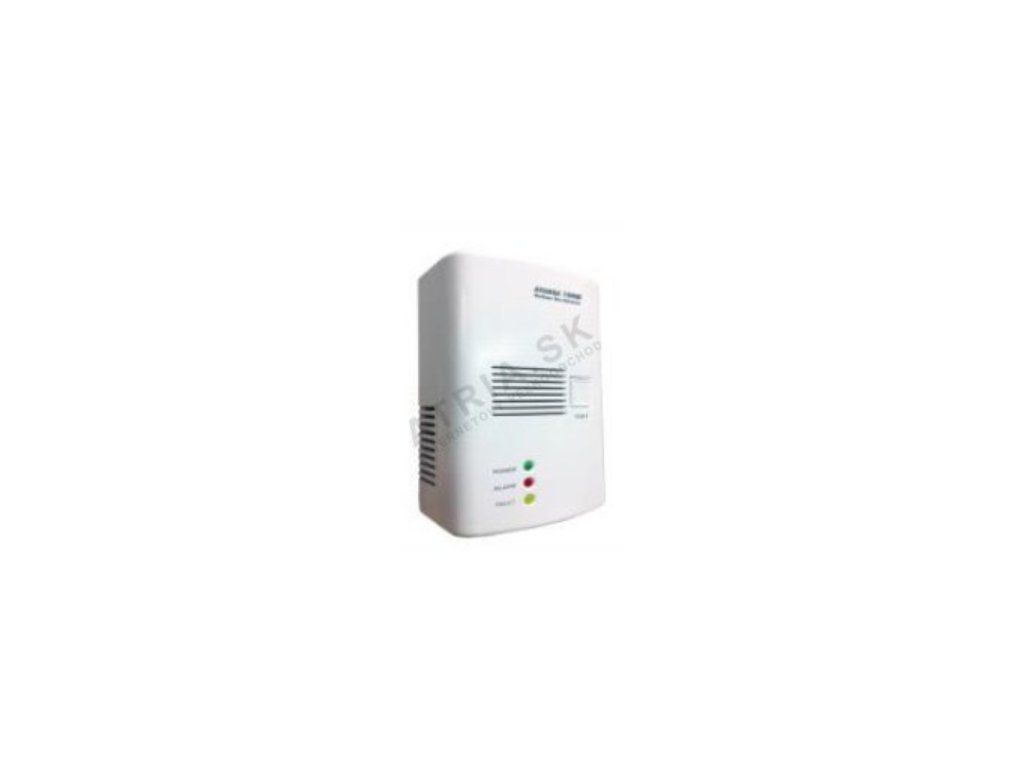
  • The Avansa 100M gas detector picks up natural gas (methane) and LPG (propane, butane). It triggers the alarm at 10% of the lower explosive limit (LEL), long before the mixture could explode. The response time is under 30 s, and the siren is louder than 90 dB at a distance of 1 m.
  • The Avansa 150MC carbon monoxide detector guards against CO – a poisonous gas that is odourless, colourless and non-irritating. It is produced by incomplete combustion, typically in solid-fuel boilers, fireplaces and stoves, but also in gas appliances with a faulty flue. The sensitivity is 150 ppm ± 80 ppm, and the siren is louder than 85 dB. Poisoning is particularly insidious during sleep, when people do not feel the symptoms.

A gas detector will not pick up carbon monoxide or smoke. If you have a gas boiler or cooker as well as a fireplace or solid-fuel boiler, you need both types.

Where to install the detector

  • Natural gas (methane) is lighter than air and collects below the ceiling – the detector belongs on the wall about 30 cm below the ceiling.
  • LPG (propane, butane) is heavier than air and stays close to the ground – the detector belongs on the wall about 30 cm above the floor.
  • A detector only picks up a leak in the room where it is installed and knows nothing about a leak on another floor. Put one in every room where gas could escape (boiler room, kitchen with a cooker) and on every floor.
  • Do not install it behind furniture or curtains, in a draught, in damp or dusty places, where solvents are released, or closer than 1.5 m to a boiler, stove or fireplace. Do not paint the detector – steam and condensation will damage it.
  • Do not place a CO detector near doors, windows or fans, or in smoky or damp places. It makes sense in a room with a combustion appliance and where people sleep.

Automatic gas shut-off with a solenoid valve

The Avansa 100M detector has a 12 V DC output for an electromagnetic (solenoid) valve that closes the main gas supply when the alarm goes off. It can only be opened manually – once the cause has been dealt with, you open it, not the automatic system. The valve body is made of brass alloy and nickel, the seal of NBR/EKM rubber; the valve is designed for both natural gas and LPG and for pressures up to 500 mbar; as a set with the detector, we offer it with G1/2" DN15, G3/4" DN20 and G1" DN25 threads. The cable between the detector and the valve can be extended, but the total length must not exceed 20 m and the polarity must be observed (white wire +, black −) – incorrect polarity will damage the solenoid. Fitting the valve into the gas pipe is a job for an authorised professional.

The range includes the standalone Avansa 100M detector, the 200M detector set with a G3/4" solenoid valve and the Avansa 150MC CO detector. You will find all models and sets on the gas and CO detectors page.

What to do when the gas detector sounds the alarm

  1. Do not use switches, doorbells or electrical appliances and do not light a flame – any spark can cause a fire or explosion.
  2. Open windows and doors and close all gas valves.
  3. Leave the area immediately. Do not make phone calls in the affected area – only call once you are outside.
  4. Contact your local gas distributor's emergency line, or the emergency number 112 if lives are at risk.
  5. Do not go back until the area has been fully ventilated and the leak has been found and repaired. Treat every alarm as genuine until you have checked all possible leak points.

If the CO detector sounds, ventilate the area immediately, get everyone out into fresh air and, if it is safe to do so, shut down the combustion appliance. In the event of headache, dizziness or nausea, call the emergency number 112.

Detector maintenance and limitations

After being plugged in, a gas detector needs a few minutes for the sensor to stabilise (the LEDs flash during this time), and a CO detector 3–5 minutes. After that, the green LED stays lit – as long as it is lit, the detector is working. Once a month, press the test button and carefully vacuum the dust from the vents; do not open the detector while doing so. Remember that a mains-powered detector does not work during a power cut and is no substitute for regular inspections of gas appliances and chimney checks.

filter_altA clean system

Magnetite and sludge in the system – why filter

If black water comes out when you bleed a radiator, you have magnetite in the system. It does not look dangerous, but it slowly destroys the pump, the boiler and the valves.

Magnetite consists of fine black particles of iron oxides produced by the corrosion of steel radiators, pipes and heat exchangers. Together with sludge, sand, scale and installation debris, they build up wherever the water slows down – and, in pumps with permanent magnets in the rotor, wherever the magnet attracts them.

What magnetite causes

  • Pump – deposits slow the rotor down, the pump hums, loses power and can seize up after the summer. Electronic pumps with permanent-magnet rotors are the most sensitive.
  • Boiler – deposits in the heat exchanger reduce heat transfer. The boiler burns more fuel, runs more noisily and the heat exchanger overheats locally.
  • Radiators – sludge settles at the bottom, so the radiator is warm at the top and cold at the bottom.
  • Valves and thermostatic heads – clogged valve plugs stick and the controls stop working.
  • Underfloor heating – the thin pipes and the flow meters on the manifolds are the first to clog; for manifolds and accessories, see brass-manifold.eu.

How a magnetic filter works

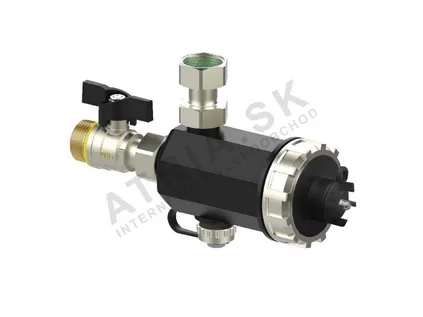
A magnetic dirt separator is installed in the return, i.e. the pipe through which water flows back to the boiler. A powerful magnet inside captures ferrous particles, and other debris is trapped in the filter. The boiler thus receives clean water, and the dirt collects in one place where you can easily remove it – instead of settling in the heat exchanger and the pump.

Aras or Caleffi DIRTMAG®?

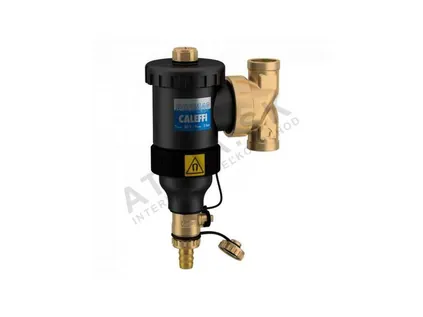
  • Aras 3/4" magnetic filter – a compact filter with a neodymium magnet that is easy to remove for cleaning, and a filter mesh for non-magnetic particles. The pack includes a G3/4" swivel connection for easy connection to the boiler, a G3/4" ball valve for isolating the circuit and a spanner. It is particularly suitable for fitting directly under the boiler.
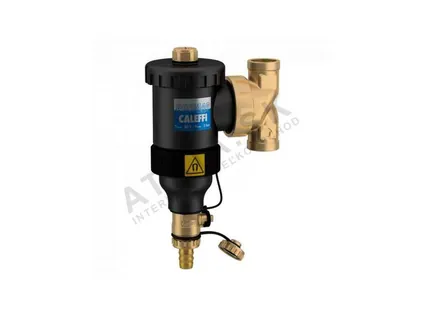
  • Caleffi DIRTMAG® 3/4" and 1" – a dirt separator with a magnet for vertical and horizontal pipes, with a technopolymer body, female threads and a drain valve with a hose connection. The maximum operating pressure is 3 bar and the operating temperature 0–90 °C. The 1" size is suitable for larger systems and larger-diameter pipework.

Cleaning the filter

  1. Switch off the boiler and the pump.
  2. Close the valves before and after the filter.
  3. With the Aras filter, remove the magnet – the particles stuck to it come loose without it. With the DIRTMAG, flush out the deposits through the drain valve with a hose.
  4. Rinse out the dirt, clean the magnet and put it back.
  5. Open the valves, check the system pressure, top up with water if necessary and bleed.

After installation in an older system, check the filter more often – it captures the most in the first few weeks. Later, a check before the heating season and during it, depending on the amount of dirt, is sufficient. If the system is heavily sludged up, consider having the whole heating system flushed by a professional; the filter will then keep the water clean.

Tip: a magnetic filter is always worth fitting when you replace the boiler or pump – otherwise the old sludge would start doing to the new equipment exactly what it did to the old.

Magnetic filters for the heating system

They protect the boiler, pump and valves against magnetite and sludge. They are installed in the return upstream of the boiler.

electric_boltBathroom

Electric heating elements for radiators

A towel radiator in the bathroom warms the room and dries the towels while the boiler is running. In spring, summer and autumn, however, it stays cold – and the bathroom stays damp. The solution is an electric heating element.

How the element works

The element (heating coil) is screwed into the bottom or top opening of the towel radiator in place of the plug. The heating element heats the water or antifreeze directly in the radiator, and the thermostat maintains the set temperature of the medium. In winter, the radiator is heated by water from the boiler; outside the heating season, electricity warms it up – without having to start the whole heating system.

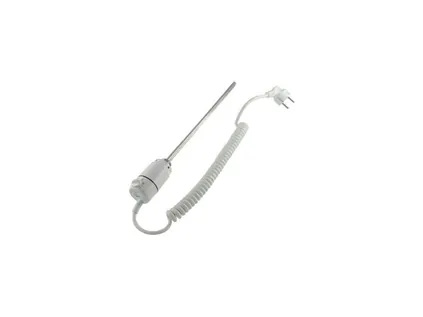
GT 900 – element with a plug-in thermostat

  • 900 W output, white finish, element length 39 cm, G 1/2" connection thread, 230 V
  • electronic rotary thermostat with a range of approx. 5–70 °C (± 3 °C), which senses the water temperature in the element, not the air temperature in the room
  • IP65 protection with a rubber seal, protection class I (requires earthing), a thermal fuse cuts the power if it overheats
  • connects with a plug to a standard socket, no need for hard-wiring; the coiled cable extends to approx. 1.5 m
  • the control housing rotates, so you can turn the thermostat to where it is easy to see; the radiator can contain water or antifreeze
  • 24-month warranty

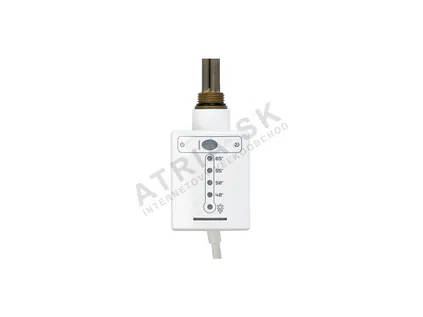
QS 600 – element with precise temperature sensing

  • 600 W output, electronic thermostat, IP65 protection
  • stainless steel heating elements for a longer service life
  • a capillary with a temperature sensor at its tip, which makes measurement of the medium temperature very accurate
  • a special fuse protects the element from overheating if the medium level drops
  • for bathroom radiators, towel rails or as an addition to an existing radiator heating system; the rear power cover is not included

Things to consider when installing

  • Check the dimensions: the thread of the opening in the radiator and whether the element will physically fit into the radiator (the GT 900 is 39 cm long). Choose an element output appropriate to the size of the radiator.
  • The radiator must be completely filled with water or antifreeze. Never switch the element on dry or outside the radiator.
  • If the radiator is connected to the central heating, discuss how to close the valves during electric operation (thermal expansion of the water) with a heating engineer.
  • The bathroom socket must have a protective earth and be protected by a residual current device (RCD), out of reach of splashing water. If you are unsure, have the installation checked by an electrician.
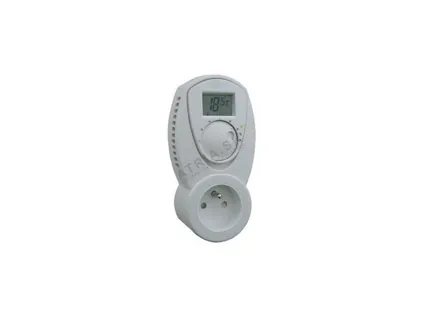
  • If your heating element has no control of its own, a plug-in thermostat connected between the wall socket and the element's power cable will keep an eye on the temperature.

You will also find electric heating elements and radiator accessories in the wider range of the ATRIASHOP.EU online store.

Heating elements and plug-in thermostat

For towel radiators and towel rails – a warm, dry bathroom even outside the heating season.

checklistChecklist

Seasonal heating check before winter

Eight steps you can get through in an afternoon – ideally in September or early October, before the first frost arrives.

System pressure

Check the pressure on the boiler gauge against the value in the boiler manual or system design. If it has dropped over the summer, top up with water and look for the cause – a dripping valve, a weeping safety valve or an expansion vessel that has lost pressure.

Bleeding the radiators

With the pump switched off, open the bleed valve on each radiator until water comes out without bubbles. Work from the lowest floor upwards and then check the pressure again at the end.

Starting the pump

After the summer, start the pump at the highest speed and listen. If it does not run or just hums, the rotor is seized with deposits. For the future, a thermostat with an anti-seize function, the Avansa 110 E, will help. More about pumps

Cleaning the magnetic filter

Close the valves, remove the magnet or drain the sludge, and flush the filter. If you do not have a filter and black water comes out of the radiators, it is time to fit one. Magnetite and sludge

Testing the backup power supply

Unplug the unit from the mains – it must switch to battery immediately and the pump must keep running. If it soon reports a flat battery, replace the battery. Check the terminals and any dust on the fan. Backup power supply

Thermostat: batteries, time and programme

Replace the AA batteries in the room thermostat, check the time and day (the clocks go back at the end of October) and adjust the programme to when you are at home. Heating settings

Testing the gas and CO detectors

Press the test button, vacuum the vents and check that the green LED is lit. A detector that is unplugged or constantly reports a fault offers no protection. Gas and CO

Safety devices and boiler servicing

With a solid-fuel boiler, check the cooling loop and the STS safety valve – cold water supply open, drain clear. Have the boiler cleaned and the chimney inspected; a gas boiler should be serviced by a technician once a year. Boiler room

ruleQuick selector

Quick selection by situation

Find your situation and you will immediately see which AVANSA product solves it and where to find out more.

Your situationRecommended solutionMore information
Solid-fuel boiler, worried about power cutsAvansa 500 W backup power supply + 46 Ah battery (set)Backup power
Several pumps, or you need a longer backup timeAvansa 700 W + 55 Ah battery, or Avansa UPS 1050 W 24 V + 2 batteriesBackup power
Risk of a solid-fuel boiler overheatingAVANSA STS safety valve for a cooling loopBoiler room
The pump keeps running even after the boiler has gone outAvansa 110 C or 110 E, or most simply the Avansa TH 2A clamp-on thermostatThermostats
Boiler with a DHW cylinder, two pumpsAvansa 110 Z (DHW priority, summer mode)Thermostats
Solar collectors with a cylinderAvansa 110 S (collector pump + circulation pump)Thermostats
Temperature control in a buffer tank or water heaterAvansa TH-2B immersion thermostat with capillaryThermostats
Pump replacement, 6/4" thread, 180 mm lengthAVANSA 25/6/180 or 25/4/180Pumps
Pump replacement, 130 mm lengthAVANSA 25/6/130 or 25/4/130; with a 1" thread, the 15/6/130 modelPumps
Larger or multi-zone systemAVANSA 25/8/180 or 32/8/180 (8 m head)Pumps
You wait a long time for hot water at the tapAVANSA CP 15-1.5 circulation pumpPumps
You want a weekly heating programmeAvansa 2007 or TH 091 programmable thermostatThermostats
You do not want to run a cable to the boilerWireless Avansa 2003 TX or 2007 TXThermostats
Simple control without a programme is enoughAvansa 2003 or the mechanical Avansa TH1Thermostats
Controlling the radiator temperature in a roomAvansa TH6 set (DN15 valve + head)Thermostat and savings
Natural gas or LPG at homeAvansa 100M gas detector, optionally with a solenoid valveDetectors
Solid-fuel boiler, fireplace, stoveAvansa 150MC carbon monoxide detectorDetectors
Black water from the radiators, noisy pumpAras 3/4" magnetic filter or Caleffi DIRTMAG®Magnetite and sludge
A warm towel radiator even in summerGT 900 or QS 600 electric heating elementHeating elements

Current prices in your currency and availability can be checked on the product cards on this website and at www.atriashop.eu. Installers and resellers will find wholesale terms at atria-europe.com.

quizFAQ

Frequently asked questions from our advice section

Do I need a backup power supply for a solid-fuel boiler if I have a cooling loop?
Yes, the two complement each other. The backup power supply keeps the pump running, so heat from the boiler is carried away to the radiators as normal. The cooling loop with the AVANSA STS safety valve is a mechanical safeguard that only kicks in when the boiler overheats above 97 °C – even when the battery is flat. More in A boiler room with a solid-fuel boiler.
What backup power supply output do I need for one pump?
Find out the power input of the pump at the highest speed it runs at (e.g. the AVANSA 25/6/180 draws 93 W). For pumps, the manufacturer recommends loading the unit to no more than 50% of its output, because they need up to twice their power input when starting. For one standard pump, the Avansa 300 W is therefore sufficient; for more loads, choose the Avansa 500 W (up to approx. 250 W in total) or the 700 W (up to approx. 350 W). Overview on the backup power supplies page.
How long can a backup power supply keep a pump running?
That depends on the battery capacity and the load. At a load of 100 W, the manufacturer states approximately 3.5 hours with a 65 Ah battery, 6.5 hours with 120 Ah and 8 hours with 150 Ah. At 200 W, it is approximately 2, 3 and 4 hours. You will find a detailed calculation in Backup power supply – sizing and battery maintenance.
What battery can I connect to an AVANSA backup power supply?
A 12 V lead-acid battery – the unit is designed to charge this type; the manufacturer does not recommend gel batteries. The Avansa 1050 W model works at 24 V, so it needs two 12 V batteries connected in series, each with a maximum of 120 Ah. The maximum capacity for the 12 V models is 90 Ah (300 W), 120 Ah (500 W) and 150 Ah (700 W). If you do not want to choose a battery yourself, go for a ready-made set with both the unit and the battery.
Why is the backup power supply beeping?
The unit announces the switch-over to battery during a power cut with a sound and on the display. When the battery is nearly flat, the beeping gets faster, and at 10.8 V the unit cuts the output so as not to damage the battery. Intermittent beeping followed by shutdown means an overload above 110% of the rated output – disconnect some of the loads or choose a more powerful model.
How do I find out which pump to buy as a replacement for my old one?
Measure the installation length (the distance between the ports, 130 or 180 mm), find out the connection thread (1", 6/4" or 2") and look up the head on the old pump's rating plate. An AVANSA designation such as 25/6/180 contains the DN, the head in metres and the installation length in millimetres. If you are unsure, call our technician on +421 917 133 664. An overview is on the circulation pumps page.
Are AVANSA pumps also suitable for underfloor heating?
Yes, AVANSA circulation pumps are designed for heating circuits, including underfloor heating. The head and flow rate are chosen according to the system design and the number of circuits on the manifold. For the underfloor circuit, we recommend adding the Avansa TH 2A clamp-on safety thermostat, which switches off the pump if the temperature is exceeded. For underfloor heating manifolds, see our specialist website brass-manifold.eu.
By how many degrees should I lower the temperature at night?
With radiators, a setback of 2 to 4 °C is common; with underfloor heating, because of its high thermal inertia, a smaller one of about 1–2 °C. A bedroom can be kept cooler during the day too, at around 17–19 °C. We cover the settings in detail in Thermostat and savings.
Why does the Avansa 2007 thermostat switch the boiler on every day at 12:00, even when I am not heating?
This is the pump protection function. If, according to the programme, the boiler has not been on for more than 24 hours, the thermostat switches it on at 12:00 for one minute so that the pump turns over and does not seize up. The anti-seize function of the Avansa 110 E boiler thermostat works in a similar way – it runs the pump for 15 seconds every 15 days.
What is the range of the wireless thermostat?
The receiver of the Avansa 2003 TX and 2007 TX thermostats has a range of approximately 50 m. Thick walls and ceilings, especially reinforced concrete, reduce the range, so test the thermostat in the chosen spot before mounting it permanently. The thermostat and receiver have their own security code, so they are not disturbed by outside radio signals.
Where should a natural gas detector be installed, and where for propane-butane?
Natural gas (methane) is lighter than air – the detector belongs on the wall about 30 cm below the ceiling. LPG (propane, butane) is heavier than air – the detector belongs about 30 cm above the floor. Not behind furniture or curtains, not in a draught, damp or dust, and not closer than 1.5 m to a boiler, stove or fireplace. More on the detectors page.
Will a gas detector also detect carbon monoxide?
No. The Avansa 100M gas detector responds to natural gas and LPG, not to carbon monoxide or smoke. CO, which is produced in solid-fuel boilers, fireplaces and stoves, for example, calls for the separate Avansa 150MC detector with a sensitivity of 150 ppm.
Does the detector work during a power cut?
No. AVANSA detectors are mains-powered and do not work during a power cut. Bear this in mind especially with solid-fuel boilers and fireplaces, which keep burning during a power cut. A detector is an important safeguard, but it is no substitute for regular inspections of gas appliances and chimney checks.
How often should the magnetic filter be cleaned?
After installation in an older system, check the filter after a few weeks – it captures the most dirt at the beginning. Later, a check before the heating season and during it, depending on the amount of deposits, is sufficient. With the Aras filter, you just remove the magnet and rinse out the dirt; the Caleffi DIRTMAG® has a drain valve with a hose connection. You will find the procedure in Magnetite and sludge.
Can a towel radiator with an electric heating element contain antifreeze?
Yes. The GT 900 element is designed for both water and antifreeze, which is commonly used in towel radiators. What matters is that the radiator is completely full – the element must never be switched on dry. The GT 900 thermostat senses the medium temperature in the element in the range of approx. 5–70 °C. More in Electric heating elements.

Need help? Ask a technician

We will answer your technical questions about AVANSA pumps, thermostats, backup power supplies and detectors on weekdays from 7:30 to 15:30 CET on +421 917 133 664 or by e-mail at info@atria.sk. All products are available from the ATRIASHOP.EU online store; installers and resellers can buy on wholesale terms via atria-europe.com.

smart_displayVideo

Product videos

Short videos showing the products, installation and settings.

descriptionPDF

Manuals and documents to download

User manuals, technical data sheets and declarations of conformity for the products on this page (PDF).

support_agentATRIA

Have a question? Write to us

Our technician usually replies on the same working day.

call+421 917 133 664 · mailinfo@atria.sk

By sending you agree to the processing of your data for the purpose of replying. Privacy